
EFFECTS OF ALLOYING ELEMENTS ON STEEL STRUCTURE
Alloy steels are steels made by adding one or more alloying elements to achieve unique properties that cannot normally be obtained from carbon steels. They contain a maximum of 2.06% Carbon.
The effect of alloying elements is most effective in the steel structure compared to other metals. In addition, since the effects of alloying elements are not additive, expected changes in properties in the presence of multiple alloying elements can only be handled within a general framework and a definitive approach cannot be made.
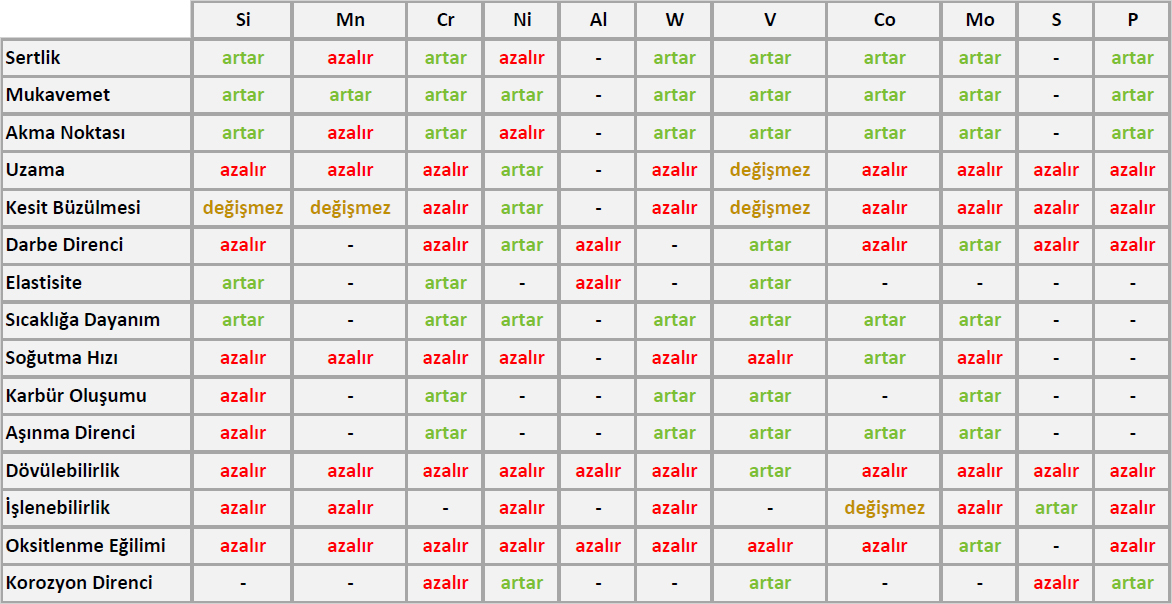
Alloy steels are divided into two main groups: those with a total amount of alloying elements less than 5% (low alloy) and those with a total of more than 5% (high alloy). The most prominent feature of low alloy steels, which behave similarly to unalloyed steels, is their higher hardenability. In addition, while strength properties such as hardness, tensile strength, yield strength, modulus of elasticity and characteristics such as heat resistance and tempering resistance increase, values such as elongation at break, reduction of area and notch impact strength generally decrease. High alloy steels are used when the desired properties are not present or are insufficient in unalloyed and low alloy steels. In such alloys, in addition to increasing the mechanical strength at normal temperatures, it is aimed to obtain some desired properties such as resistance to heat, scaling and corrosion, hardness at temperature and non-magnetization.
KARBON (C)
It is the primary alloying element for steel. With an increase in the amount of carbon, hardness and strength increase significantly. Tensile stress and yield strength increase up to 0.8% carbon. After this value, brittleness increases, and the hardness after heat treatment does not increase further due to retained austenite. The maximum hardness that steel can achieve is 67 HRC, which is obtained with a 0.6% carbon content. Increasing the amount of carbon also reduces ductility, forgeability, deep drawability, and weldability. The risk of cracking during the heat treatment of high-carbon steels is also high.
MANGAN (Mn)
It usually enters the structure while in the ore state. It is also added to improve mechanical properties and can act as a basic alloying element. It generally increases the strength of steel while reducing ductility. Up to a 3% Mn content, for every 1% Mn, the tensile strength increases by approximately 100 MPa. Between 3% and 8%, the increase slows down. A decrease is observed from 8% onwards. It improves the forgeability and hardenability of steel. It does not affect weldability and can be increased up to 1.6% in weldable materials. The positive effect of manganese increases as the carbon ratio increases.
SILICON (Si)
It is used as a deoxidizer during steel production. In cast steels, it can be added to provide fluidity to the casting. Since it has the ability to dissolve in ferrite, it increases strength and hardness without reducing the ductility and toughness of the material. Steels with high silicon content also have high heat resistance. Although it generally increases hardenability, wear resistance, and elasticity, it adversely affects surface quality.
SULFUR (S)
Sulfur combines with iron to form the FeS phase. Since this phase has a low melting temperature, it melts at rolling temperatures and causes hot shortness. This negative effect is prevented by ensuring that sulfur combines with manganese. It causes 'red shortness' during deformation between 800°C and 1000°C, and 'burning shortness' at temperatures above 1200°C. For these reasons, it is considered a harmful element for steel and efforts are made to eliminate it. However, it is used in free-cutting steels by adding twice as much Mn to increase machinability. It generally has a negative effect on weldability and hardenability.
FOSFOR (P)
It is a harmful element that reduces material toughness with its presence. Although it has the property of increasing the strength and hardness of steel, it reduces ductility and impact strength. This effect is more clearly seen in high-carbon steels. It is aimed to keep it as low as possible in steel, and the low amount of phosphorus along with sulfur is the primary criterion for material quality.
KROM (Cr)
It is the most frequently added alloying element to steels. Chromium added to steel directly increases hardness by forming hard carbides such as Cr7C3 and Cr23C6. It also increases the depth of hardness by slowing down transformation rates. When chromium is added in values up to 25%, it forms an oxide layer on the material surface, providing rust resistance and giving the material a bright appearance. It also increases tensile strength and heat resistance. It may cause temper brittleness or reduce ductility in some alloys. To reduce these effects, it is mostly used in combination with Ni and Mo.
NICKEL (Ni)
Nickel is widely used in alloy steels in proportions up to 5%. Nickel increases the strength and toughness of the material. It is particularly prevalent in austenitic stainless steels (7-20%). Nickel also has a grain-refining effect. The use of nickel alone as an alloying element has decreased in recent years, and Ni-Cr alloys, especially Ni-Mo or Ni-Cr-Mo alloys, have become widespread. In addition to improving resistance to heat and scaling, it increases hardening, ductility, and high fatigue resistance when used with chromium.
MOLYBDENUM (Mo)
Molybdenum is used in steels containing low nickel and low chromium to eliminate the tendency for temper embrittlement. An addition of around 0.3% molybdenum ensures this. The impact strength after tempering of nickel and chromium steels with molybdenum additions is also significantly increased. It also increases yield and tensile strength. It increases the wear resistance of steels. In stainless steels, it significantly increases corrosion resistance, especially because it prevents pitting corrosion. In some microalloyed steels, molybdenum is used as an alloying element to form nitrides or carbonitrides.
VANADYUM (V)
Like nickel, vanadium is also an important grain refiner for steels. Even its use in a ratio like 0.1% significantly prevents grain coarsening during the hardening process and substantially increases yield and tensile strengths. Vanadium also increases hardness depth and temperature resistance. It is particularly effective in maintaining the shape of cutting edges for a long time by ensuring an increase in impact strength. Vanadium is a microalloying element used in combination with niobium and titanium in microalloyed steels. In microalloyed steels, the total of alloying elements does not exceed 0.25%. These elements, in single, double, and triple compositions, refine the grain size with carbonitride precipitates formed in the microstructure and increase strength through the precipitate hardening mechanism.
VOLFRAM (W)
Tungsten is an alloying element that increases the strength of steel. In tool steels, it ensures the maintenance of cutting edge hardness, extends tool life, and provides high temperature resistance. For this reason, it is used as an alloying element especially in high-speed steels, tool steels, and quenched and tempered steels. Since it prevents the steel from tempering and losing its hardness at high operating temperatures, it is used in the production of heat-resistant steels.
TITANIUM (Ti)
It has a strong carbide-forming property and increases hardness. It is used as a microalloying element in microalloyed steels. It is also used as a carbide-forming alloying element in stainless steels to eliminate the negative effect of chromium carbide. It is also used as a deoxidizer during steel production. It has a better grain-refining effect than vanadium.
NIOBIUM (Nb)
It is the microalloying element with the highest grain-refining effect in microalloyed steels. It has the same effect as titanium in stainless steels and is used together with titanium or alone. It also increases the yield strength. It increases hardness with its strong carbide-forming property.
ALUMINUM (Al)
It is the strongest deoxidizer. It shows an increasing effect on yield strength and impact toughness. High aluminum content causes nozzle clogging in continuous castings. In addition, aluminum has a grain-refining effect and is the primary alloying element of nitriding steels. It is also used in some microalloyed steels as a microalloying element forming nitrides and carbonitrides. It reduces grain coarsening on heating and aging.
KOBALT (Co)
It slows down grain growth at high temperatures, so it is added mostly to speed steels and heat-resistant steels. It is used to maintain the hot hardness of tool steels.
BAKIR (Cu)
Since it causes brittleness in hot forming, a ratio of 0.5% is rarely exceeded. Although it seriously reduces ductility, it increases corrosion resistance and is added because it increases hardness. It increases yield and tensile strength. It exhibits an effect that raises corrosion resistance.
BOR (B)
It increases hardenability in low and medium carbon steels. It is added to killed steels in small proportions of 0.0005 - 0.003%.
KALAY (Sn)
It does not affect yield and tensile strengths much, but creates problems in hot rolling. Tin forms compounds with low melting temperatures, causing ruptures during rolling.
LEAD (Pb)
It reduces rollability. It causes breakages during rolling and adversely affects surface quality. It causes issues in continuous casting. Lead increases the machining capability of steels, hence it is used as an alloying element in free-cutting steels.